Every marble slab that enhances an elegant living room, every travertine countertop that defines a luxury kitchen, every natural stone cladding that shapes a refined bathroom has an extraordinary journey behind it. A journey that begins in the heart of the Italian mountains and ends in the world’s most exclusive spaces, passing through centuries of tradition, artisanal mastery, and technological innovation.
This is the journey of Italian natural stone: a story of transformation, passion, and dedication to excellence—one worth telling.
In the heart of the mountain
Identifying the deposit
It all begins with geology. Italian quarries are not simply extraction sites, but the result of in-depth geological studies that can take years. Geologists examine soil composition, analyze rock samples, and study stratifications to identify the most promising deposits.
Italian mountains hold treasures formed millions of years ago. Marble, for example, originates from the metamorphosis of limestone rocks subjected to extreme temperatures and pressures deep within the Earth. This process created the unique veining, distinctive colors, and crystalline structure that make each block an unrepeatable natural work of art.
The art of extraction
Extracting natural stone is an art in Italy, passed down from generation to generation. Master quarrymen possess an intuitive understanding of the mountain: they know how to “read” the rock, where and how to cut it to obtain the highest-quality blocks while minimizing waste.
Traditional techniques had a particular charm: cutting with helical wire, using wooden wedges soaked in water which, as they expanded, split the rock along its natural lines. While these methods have largely been replaced by modern techniques, the philosophy remains the same—respect the stone, follow its nature, never force it.
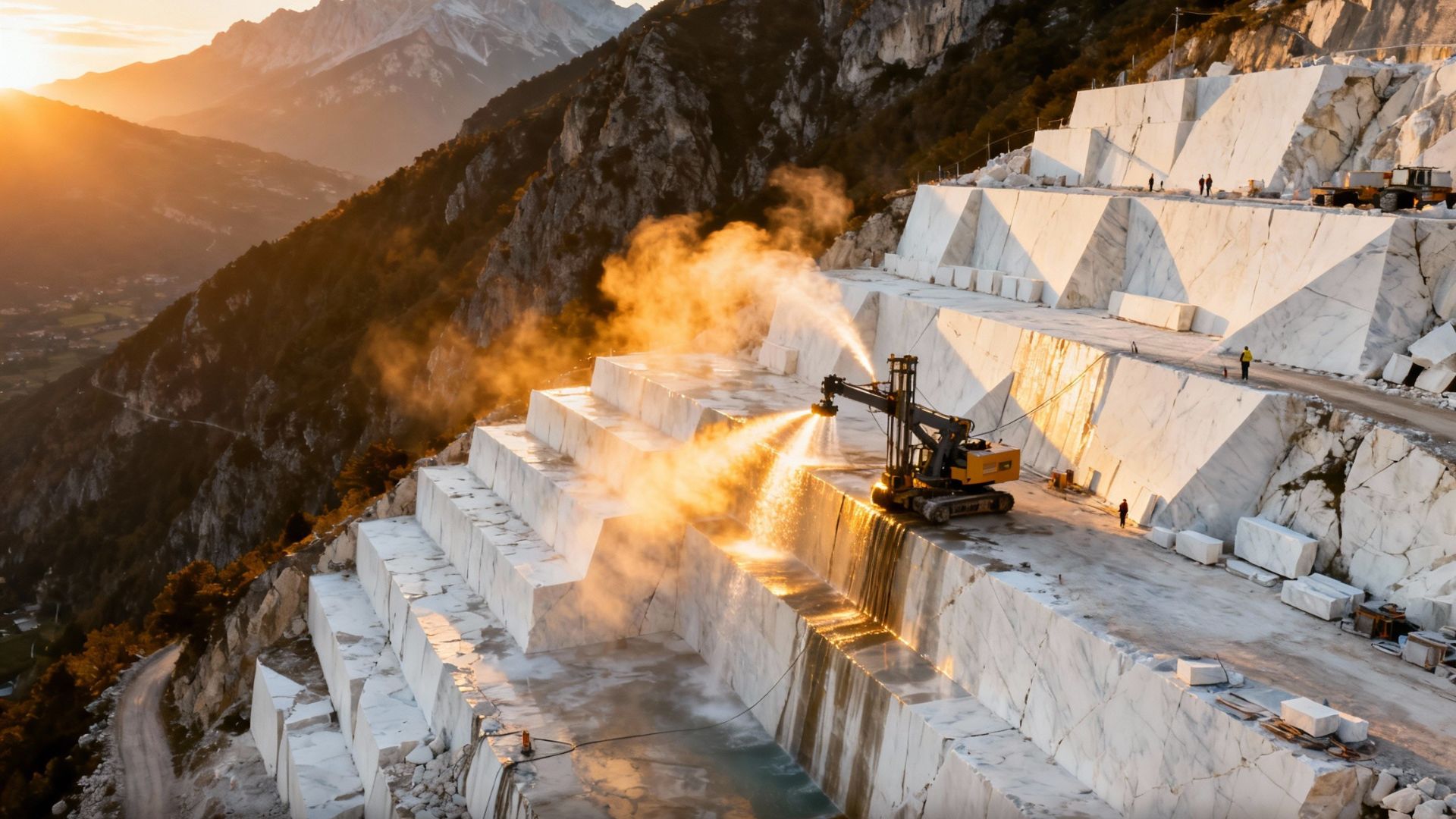
Contemporary technologies have revolutionized extraction without betraying its artisanal spirit. Diamond wire cutting ensures millimetric precision; chain saws cut with extraordinary efficiency; computerized handling systems move blocks weighing tens of tons with surprising delicacy.
In a modern Italian quarry—like those from which Marmeria Italiana selects its materials—technology and tradition dance together. Operators use state-of-the-art machinery while maintaining the trained eye of the artisan, capable of instantly assessing the quality of a freshly extracted block.
Selection: the expert’s eye
Not all extracted blocks are the same. Even from the same quarry, the same vein, stones with different characteristics can emerge. This is where the selector’s experience comes into play.
When visiting a quarry, a Marmeria Italiana expert evaluates multiple aspects:
- Compactness: a dense structure guarantees superior durability and workability
- Veining: the natural pattern must be harmonious, distinctive yet balanced
- Color: uniformity or chromatic variation must meet strict quality standards
- Natural fractures: even micro-fractures invisible to the eye can compromise a block
- Size: larger blocks allow for bigger slabs, reducing joints in finished projects
Only blocks that meet these rigorous criteria continue their journey toward transformation into finished products.
Transformation
The journey to the workshops
Selected blocks—each weighing several tons—are transported to processing facilities. This transfer requires complex logistics: specialized cranes, reinforced trucks, carefully planned routes to minimize vibrations that could damage the stone.
In modern Italian plants, the arrival of a new block is a significant moment. Each block is catalogued, photographed, and digitally mapped. An identity record is created, accompanying the material through every subsequent phase.
Cutting: revealing hidden beauty
The first cut of a block is always a moment of discovery. Even the most experienced expert feels a thrill of anticipation: what will the interior reveal? What patterns will emerge? Every block is a surprise.
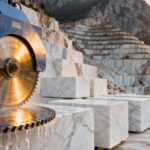
Diamond blade saws perform the main cuts, slicing the block into slabs of the desired thickness. The process is slow and meticulous: a blade spinning at thousands of revolutions per minute advances millimeter by millimeter through tons of stone, continuously cooled by water to prevent overheating that could alter the marble’s structure.
Multi-wire saws allow multiple slabs to be produced simultaneously, optimizing yield. Dozens of parallel diamond wires pass through the stone at the same time, creating perfectly parallel slabs.
In cutting-edge facilities, 3D scanning systems analyze each block before cutting, enabling optimal planning that maximizes yield and enhances the stone’s natural aesthetic characteristics.
Finishing: from rough to refined
A freshly cut slab is rough and matte, revealing only a hint of the beauty it holds. It is through finishing that the stone reveals its full splendor.
Grinding is the first step: progressively finer abrasive discs remove saw marks, smoothing the surface. The process begins with coarse grits and gradually moves to finer ones, often requiring multiple passes.
Polishing brings the stone to its highest brilliance. Using increasingly fine abrasive powders and polishing discs, the surface reaches a mirror-like sheen that highlights veining and color depth. A properly polished Bianco Carrara marble almost seems to glow from within, reflecting light with incomparable radiance.
Special finishes offer alternative aesthetics:
- Brushing creates a lightly textured surface, ideal for rustic or contemporary settings
- Flaming produces a rough, slip-resistant finish, perfect for outdoor flooring
- Bush-hammering creates a refined, subtly dotted texture
- Sandblasting delivers a sophisticated matte finish
Each finish dramatically alters the stone’s appearance and tactile qualities, adapting it to different applications and design styles.
Treatments and protection
Before leaving the workshop, slabs may receive protective treatments. Water- or solvent-based impregnators penetrate the stone’s pores, creating an invisible barrier against stains and moisture without altering its natural appearance.
Developed through years of research, these treatments represent the perfect union of science and nature: they protect without altering, preserve without changing the stone’s essence.
From workshop to project
Consulting: finding the perfect stone
The stone’s journey now intertwines with that of the project. Architects, interior designers, or homeowners turn to specialists like Marmeria Italiana to find the perfect material for their vision.
This phase is crucial. It’s not just about choosing a beautiful material, but identifying the stone that precisely meets the project’s functional and aesthetic requirements. An expert consultant considers:
- The destination environment: bathroom, kitchen, living area, outdoor space
- The project style: classic, contemporary, minimalist, eclectic
- Usage conditions: foot traffic, water exposure, temperature variations
- Lighting: natural or artificial, which deeply affects stone perception
- Budget: always aiming for the best quality–price ratio
With over 35 years of experience, Marmeria Italiana has developed a unique ability to match clients with the right stone—often exceeding initial expectations.
Customization: made-to-measure cutting
Every project is unique, and the stone must fit it perfectly. Processing workshops receive detailed specifications: exact dimensions, special shapes, customized thicknesses, and shaped cuts.
CNC (Computer Numerical Control) technologies ensure absolute precision. Ultra-high-pressure waterjets mixed with abrasives cut stone along digitally programmed paths, creating complex shapes, elegant curves, and perfect joints.
Five-axis machining centers can mill, drill, chamfer, and create complex three-dimensional profiles. A kitchen countertop with an integrated drainer, wall cladding with shaped niches, a staircase with uniquely formed steps—everything is possible.
Quality control: certified excellence
Before shipment, every piece undergoes rigorous checks. Dimensions are verified with precision instruments; surfaces are inspected for imperfections; strength is tested according to international standards.
Only pieces that pass these checks receive a quality certificate and are prepared for shipment. It’s a guarantee for the client: the stone they receive is exactly what was promised, with no surprises or compromises.
Packaging: protecting a treasure
A slab of fine marble can be worth thousands of euros. Protecting it during transport is essential. Packaging is a science: protective sheets, reinforced corners, custom wooden crates, fastening systems that prevent movement while absorbing vibrations.
Every detail matters. Inadequate packaging can ruin months of work; excellent packaging ensures the stone arrives in the same condition it left the workshop.
Installation
Logistics: perfect coordination
Transporting stone requires meticulous coordination. International shipments to Dubai, Rome, or Singapore involve customs documentation, comprehensive insurance, and specialized carriers.
Marmeria Italiana manages every logistical aspect, ensuring materials arrive on time and in perfect condition, ready for installation.
Installation: the final transformation
It is on-site that the stone completes its transformation. Specialized craftsmen—often with decades of experience—turn slabs and shaped pieces into the final design element.
Substrate preparation is crucial: it must be perfectly level, clean, and moisture-free. An inadequate substrate compromises the entire installation.
Installation demands millimetric precision. Installers work with laser levels, use stone-specific adhesives, and carefully manage joints to make them virtually invisible—or deliberately visible, according to the design.
In large surfaces, joints are designed to be discreet while allowing natural material expansion. In prestigious projects, slabs may be paired to create continuous veining, a process known as book matching, requiring exceptional skill and sensitivity.
Final finishing
Once installed, the stone receives final care: thorough cleaning to remove installation residues, possible restoration of polish in areas slightly abraded during installation, and application of protective sealers if not already done.
The life of the stone
Durability over time
The stone’s journey doesn’t end with installation. Rather, its true life begins—decades, centuries of service and beauty. The marble floors of Rome’s Pantheon, laid nearly 2,000 years ago, are still there, silent witnesses to the extraordinary durability of Italian natural stone.
With proper maintenance, a high-quality Italian marble floor can outlast the building itself. It is a material without obsolescence: a Carrara marble or Roman travertine installed today will be just as beautiful and desirable a hundred years from now.
Maintenance: preserving beauty
Natural stone requires care, but it is not as fragile as some fear. With proper cleaning routines and periodic treatments, it maintains its original beauty:
- Daily cleaning: soft cloth and neutral, pH-balanced cleaners
- Protection: coasters, placemats, precautions against acidic substances
- Periodic maintenance: professional repolishing every few years, renewal of sealers
Marmeria Italiana provides detailed maintenance guidance, ensuring clients’ investments are protected over time.
Sustainability: closing the circle
Even at the end of its life, natural stone retains value. It can be recovered, reprocessed, and reused. Many contemporary projects incorporate reclaimed historic marble, creating a fascinating bridge between past and present.
Processing waste is not waste but a resource: transformed into aggregates, terrazzo components, or raw materials for other products. The Italian stone industry is increasingly oriented toward a circular economy, closing the loop of the stone’s life cycle.
A journey of excellence
From quarry to design, the journey of Italian natural stone is a story of continuous transformation—physical transformation from raw block to polished surface; transformation of value from raw material to design element; transformation of meaning from natural resource to symbol of quality and beauty.
It is a journey that requires expertise, passion, and respect for both material and environment. A journey that, in Italy, unfolds according to standards of excellence built over centuries of tradition and perfected through contemporary innovation.
When you choose Italian natural stone, you are not simply purchasing a building material. You are welcoming into your home or project the result of this extraordinary journey—a piece of Italian mountain, shaped by expert hands, destined to bring beauty and value for generations.
With its 35 years of experience and commitment to excellence at every stage of the process, Marmeria Italiana is the ideal partner to guide you on this journey—from selecting the perfect block at the quarry to the final realization of your design project.